

The .NET ecosystem has evolved over the past few years. The traditional .NET framework moved towards unified .NET platforms to focus on cross-platform development, cloud-readiness, performance, and developer productivity.
Microsoft released .NET 10 as a Long-Term Support (LTS) release, providing three years of support and stability for enterprise workloads.This article talks about how to explore .NET 10 features, its advantages, practical use cases and best practices for any organization in teams planning migration.
Why .NET 10 Matters?
.NET 10 helps development teams build scalable applications using less resources and better maintainability. The modern application development requires:
Fast performance
Stronger security
Cloud-support architectures
AI capabilities
Easy deployment
Low infrastructure cost
.NET 10 addresses these requirements while maintaining backward compatibility and improving developer productivity.
Key Features of .NET 10
1.Runtime Performance and Optimized JIT Compilation:
Optimized JIT compilation, enhanced method inlining, loop unrolling, and hardware acceleration support allows demanding workloads to improve performance all over. While performance was the most important advantage of .NET it continued to extent in .NET 10. To make high-volume APIs and microservices more efficient, it is important to implement new stack strategies for small arrays. The latest updates in .NET 10 like method devitalization, loop optimization, improved code generation, AVX10.2 hardware acceleration supports help:
Reduce CPU usage
Low memory allocation
Improve application performance
Low latency in long run applications
Code Example:
public readonly struct ProductData
{
    public int Id;

    public decimal Price;
}
2. Advanced JSON Serialization:
Modern APIs rely heavily on JSON processing and .NET 10 are continuously improving serialization performance, data validation, and memory efficiency. There are certain features like duplicated property detection and enhanced PipeReader support that make API communication more reliable and predictable.
The updated serialization helps reduce memory allocation and lower bottlenecks and contributes to better scalability and overall system performance for high traffic APIs.
.NET10 introduced:
Faster JSON serialization and deserialization
Stronger payload validation
Better API scalability
Faster large payloads processing
The above capabilities allow API communication to be more predictable, secure, and efficient.
Code Example:
builder.Services.ConfigureHttpJsonOptions(options =>
{
    options.SerializerOptions.AllowTrailingCommas = false;
});
3. ASP.NET Core 10 Enhancements:
ASP.NET Core is a framework for building web apps and APIs, which focuses on improving developer productivity, application performance, and security. These new and better enhancements allow to build scalable web solutions and on the other side reduce developing complexity and maintenance efforts
ASP.NET offers:
OpenAI improvements
Better Minimal APIs
Improved diagnostic
Blazor performance enhancements
Identity passkey support
These updates allow development teams to deliver secure, high-performance applications that are more efficient.
Code Example: Minimal API example
app.MapGet("/products", () =>
{
    return Results.Ok(products);
});
4. Improved SDK and CLI Experience:
The development team’s productivity just received a boost with the latest .NET SDK updates. The latest updates allow developers to build and deploy applications that need fewer external dependencies and simple workflows. The new capabilities include:
Enhanced CLI commands
Platform specific tooling
Test execution support
Enhanced file-based application
Native container image generation
Code Example: Create a Container image
dotnet publish --os linux --arch x64 /t:PublishContainer 5. Strong Security and Cryptography:
Security is an important point of attention when handling sensitive user data in an application. This is why .NET 10 introduced updates like:
Extended post-quantum cryptography support
Improved TLS 1.3 support
Enhanced AES KeyWrap
Improved certificate handling
The above additions have significantly helped development teams to prepare the organization for future security vulnerabilities and improve current security standards.
6. NativeAOT for Cloud-Native Applications:
Native Ahead-of-Time (NativeAOT) compilation is further enhanced in .NET 10:
Faster startup times
Smaller deployment packages
Less memory allocation
Better performance in server-less environments
These are particularly used for AWS Lambda, Azure Functions, Containerized APIs, and Edge computing workloads and those organizations that are looking to reduce cold-start latency with NativeAOT.
Lastest features of .NET 10
1. AI development in .NET 10:
AI development in .NET 10 significantly encouraged application development with simple built-in tools and frameworks to implement scalable, intelligent and production -ready solutions with the .NET ecosystem. .NET 10 provides AI assistants Retrieval-Augmented Generation (RAG) systems and workflow automation this enables AI adoption across teams.
AI features in .NET 10:
Microsoft.Extension.AI:
This allows integration of AI models and services with standardized abstraction across all .NET applications.
AI agent framework:
Developers can build autonomous AI agents that are seamlessly capable of reasoning, planning and executing complex enterprise workflows.
Semantic Kernel Integration:
This integration enable simplified orchestration of Large Language Models (LLMs), plugins and business logics in .NET 10 applications.
OpenAI Integration:
This feature allows easy integration with OpenAI models like chatbots, content generation and intelligent automation.
Vector search support:
This promotes semantic search and RAG systems for successful storing and query vector embedding.
2. Modern application in C# 14:
C# 14 enhancements introduced developer productivity by introducing multiple language enhancements helped code readability and reduced boilerplate code. The .NET 10 combines these capabilities with performance improvements that allow developers teams to build scalable, modern applications that are faster and maintain code quality.
Important features of C# 14:
Field-backend properties:
Access the compiler-generated backing field directly within property accessors, enabling validation and transformation logic without manually declaring fields.
Partial events:
Create events across partial class files which makes it easier for larger applications to organise and maintain.
Partial constructors:
Allows constructors implementation to be divided across partial class defined, which improves code generation and framework integration.
Extension member improvements:
Allows enhanced extension methods and properties the flexibility to enable better API and cleaner codes.
Nullable condition aaasignments:
Reduces repetitive null checks and code readability to simplify null-safe assignments.
Improved lambda expression:
The functional programming patterns become more concise and intuitive with better type interference and syntax enhancements.
Advantages of using .NET 10
1.Improved Application Performance:
Application performance benefits faster execution and low resource consumption and does not require extensive code changes.
This allows organizations to:
Handle more concurrent users
Enhanced user experience
Lower cloud infrastructure costs
2.Better Cloud-Native Development:
.NET 10 supports better cloud-native architecture alignment. This allows .NET 10 to be ideal for workloads that run on Kubernets, Azure, AWS, and Google Cloud.
Following are the benefits of cloud-hosted development s:
Container-friendly deployment
Faster microservices
Enhanced observability
NativeAOT support
3.Enhanced Security:
The latest security improvements enabled development teams to implement protection that is stronger, without relying on third-party libraries. This results in reduced maintenance complexity, contrary to improving compliance readiness.
4.Long-term Support Stability:
When an LTS is released, .NET provides support for 3 years and this helps enterprise applications are predicted to be critical and stability.
Real-world Use Cases for .NET 10
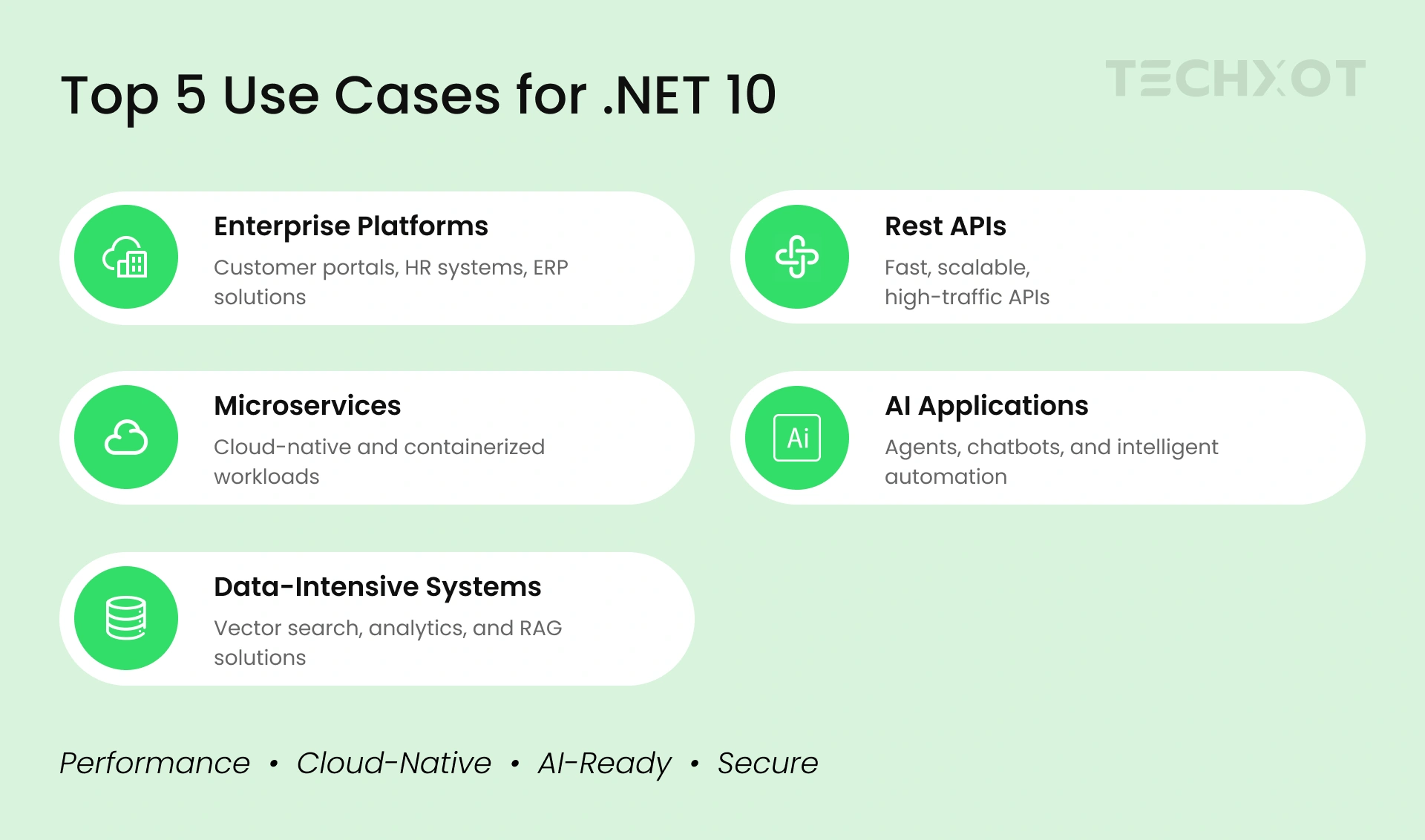
Best Practices for Migration to .NET 10
1.Start with Auditing dependencies
Audit dependencies before upgrading
Review NuGet packages
Validate third party libraries
Check compatibility documentation
2. Benchmark Before and After
It is important to monitor performance so measure:
Startup time
Memory allocation
Throughput
API response times
Use tools like:
dotnet-counters
dotnet-trace
BenchmarkDotNet
3. Leverage Cloud Hosting
It is important to use containerized deployments to increase scalability and portability. And users recommended hosting environments like:
Microsoft Azure
Amazon Web Services
Google Cloud Platform
4.Adopt NativeAOT
Not all applications need Native AOT. When developer s needs to prioritize startup speed and memory efficiency they need to focus on:
APIs
Server-less functions
Edge workloads
Background services
.NET 10 has significantly moved forward in modern application development. The teams that are using ASP.NET Core who upgrade to .NET 10 this offer benefits in maintainability, operational efficiency and productivity.
At Techxot, we help enterprises unlock full potential of .NET 10 capabilities with design, development and optimization of high-performance web apps, provide cloud-native solutions and deploy enterprise platforms that align with your business goals.
For organizations that are planning their upgrades, it is important to start with evaluating .NET 10 to improve performance gains, modern tooling and future-proof architectures, scalability and long-term ROI.
Get in touch with Techxot to discuss and discover how modern .NET deployment can help your business improve performance, scalability and growth.